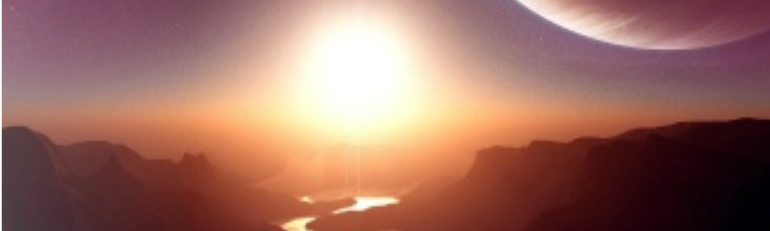
Titan And Its Future
Titan is one of the largest moon in saturn and it is second largest moon in the whole solar system and is the only natural satilite known to have a dense atmosphere and the only object other than Earth for which clear evidence of stable bodies of surface liquid has been found. Frequently described as a planet-like moon, Titan has a diameter roughly 50% larger than Earth'smoon and is 80% more massive. It is the second- largest moon in the Soalr System, after Jupiter's moon Ganymede, and it is larger by volume than the smallest planet, Mercury, although only half as massive. Titan was the first known moon of Saturn, discovered in 1655 by the Dutch astronomer Christiaan Huygens. The moon itself is primarily composed of water ice and rocky material.The surface is geologically young; although mountains and several possible cyovolcano have been discovered, it is smooth and few impact craters have been discovered. The atmosphere of Titan is largely composed of nitrogen; minor components lead to the formation of methane and Ethane clouds and nitrogen-rich organic smog. The climate—including wind and rain—creates surface features similar to those of Earth, such as sand dunes, rivers, lakes and seas (probably of liquid methane or ethane) and shorelines, and, like on Earth, is dominated by seasonal weather patterns. With its liquids (both surface and subsurface) and nitrogen atmosphere, Titan is viewed as to the early Earth, although at a much lower temperature. Researchers have suggested a possible underground liquid ocean might serve as a biotic environment.It has also been suggested that a form of life may exist on the surface, using liquid methane as a medium instead of water.
Here is a video we wold like to show you!